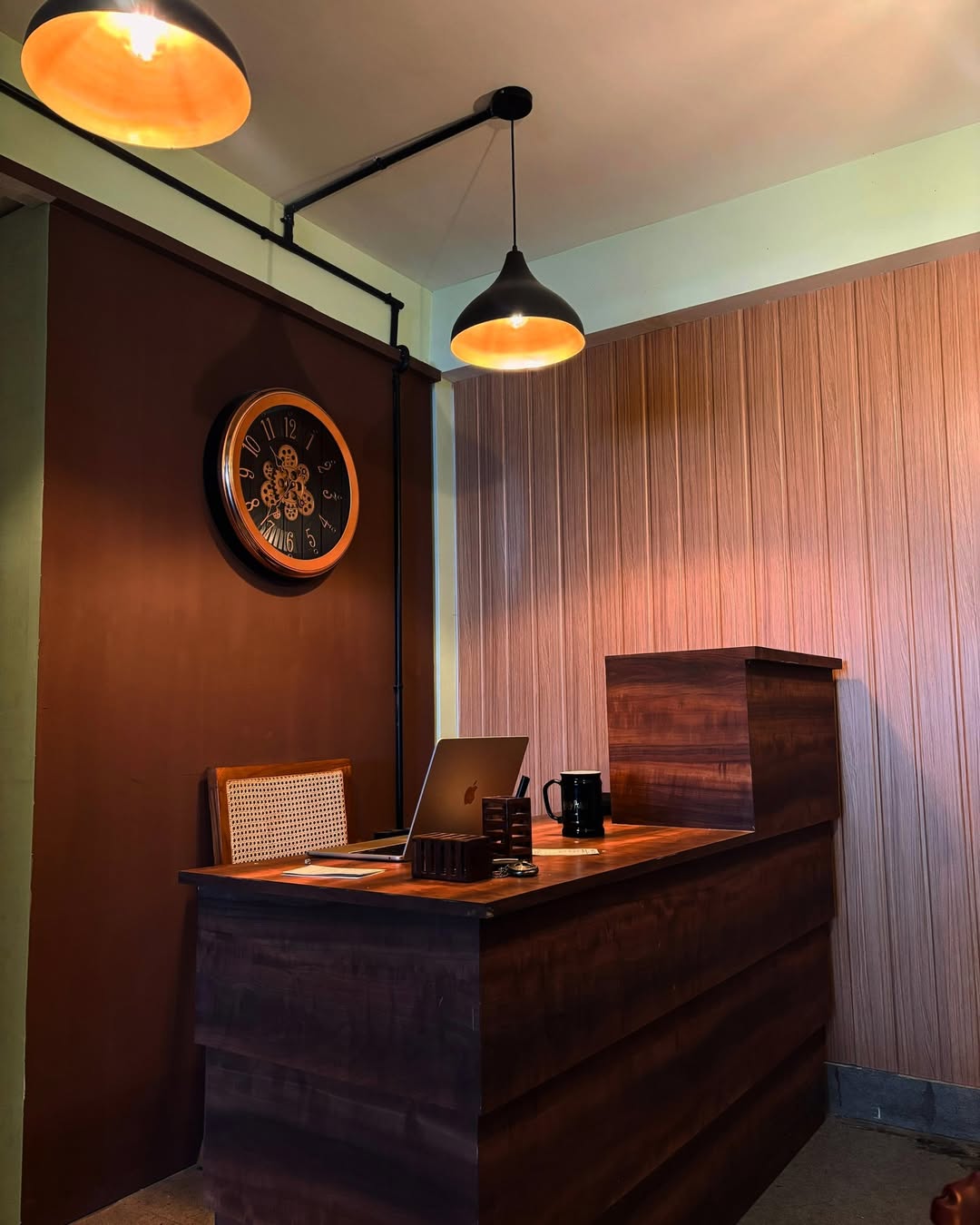
Sanctorum started with a simple observation: Gangtok had no shortage of talented people, but nowhere for them to work seriously. This is the story of what we built, and why.
Every interaction inside Sanctorum — the conversation at the coffee machine, the late-afternoon debate about pricing strategy, the stranger who glances at your screen and says "you should try this" — we count these as part of the work. Not distractions from it.
There's a body of research, and more importantly a lived experience, that confirms what most people intuitively know: your environment shapes your thinking. Put the right people in the right setting, and certain things start happening almost automatically. Ideas surface. Collaborations form. People who were stuck become unstuck.
Sanctorum was designed to be that setting. Not a place you tolerate to get work done, but a place that actively makes the work better.
History keeps proving the same point. Concentrated environments — physical places where ideas and people collide — produce results that isolated individuals can't.
The Medici family turned Florence into a laboratory in the 15th century by simply putting artists, architects, philosophers, and scientists in the same city and funding the friction between them. The Renaissance wasn't inevitable. It was deliberately created.
English coffeehouses in the 1600s became the operating theatres of the Enlightenment — penny admission, unlimited coffee, open debate. Halley's comet, Lloyd's of London, and the Royal Society all have origins in those rooms.
Sanctorum isn't claiming to be Florence or a 17th-century coffeehouse. But it is making the same bet: that when you build the right room, interesting things happen inside it.
The Medici family didn't create the Renaissance — they created the conditions for it. By concentrating artists, thinkers, and builders in one city and removing the friction of survival, they catalysed an era that reshaped Western civilisation.
For a penny, any Englishman could sit alongside scientists, merchants, and philosophers and argue all afternoon. The information exchange that happened in those rooms — Lloyd's of London, the stock exchange, modern science — wasn't incidental. It was the point.
Sikkim has 300–500 skilled digital workers, 1.6 million annual visitors, and a government actively designating Gangtok as a remote-work destination. It had zero dedicated professional workspace. We built one.
In 2015, I tried to build something for Northeast India — a blog that would connect artists, creators, and entrepreneurs across the region. It didn't survive, but it taught me something important: the talent was always here. What was missing was the infrastructure for it.
When I became a freelance designer, the workspace problem became personal. We tried renting an office once. The costs, the paperwork, the commitment — it made no sense for the kind of work we were doing. So we went back to cafés and hotel lobbies, which worked fine until it didn't.
The thing that finally pushed me to build Sanctorum was a specific memory. Early in my career, I sat next to a colleague for three days and learned Adobe Illustrator — properly learned it — in a way that months of online tutorials had failed to teach me. Proximity did what instruction couldn't.
That's the thing about working alone: you don't know what you're missing until you're suddenly next to someone who knows something you don't. Sanctorum exists to create more of those moments.
The pandemic settled something that office evangelists had resisted for decades: working from home is genuinely productive. For many people, removing the commute, the open-plan noise, and the performative busyness actually improved both the work and the life around it.
But it also revealed the other side of that coin. Not everyone has a quiet apartment, a supportive household, or the kind of temperament that thrives in isolation. For a lot of young professionals — particularly in a city like Gangtok, where many people are still living with their families — working from home means working in the middle of everything else. The productivity gains disappear. So does the separation between work and not-work.
The camaraderie. The ambient learning. The version of yourself that shows up when someone else is watching — not because you're performing, but because their presence raises your standard slightly. These things matter, and no amount of video calls replicates them cleanly.
Sanctorum was built for this gap. Not as a replacement for the home office and not as a return to the traditional office — but as a third option. A place to go when you need to work seriously, around other people working seriously, without the bureaucratic weight of corporate infrastructure.
We've kept the space deliberate. The acoustics are thought about. The chairs are chosen. The coffee is good and it's always there. These aren't amenities for a brochure — they're the difference between a space that respects your work and one that merely tolerates it.
And we've built it here, in Gangtok, at 1,650 metres, surrounded by the Eastern Himalayas — because Sikkim's people deserve infrastructure that matches their ambition, and because the remote workers and digital nomads arriving in this city deserve somewhere worthy of the view.
Monthly memberships open now. Day passes opening June 2026. WhatsApp us to visit.